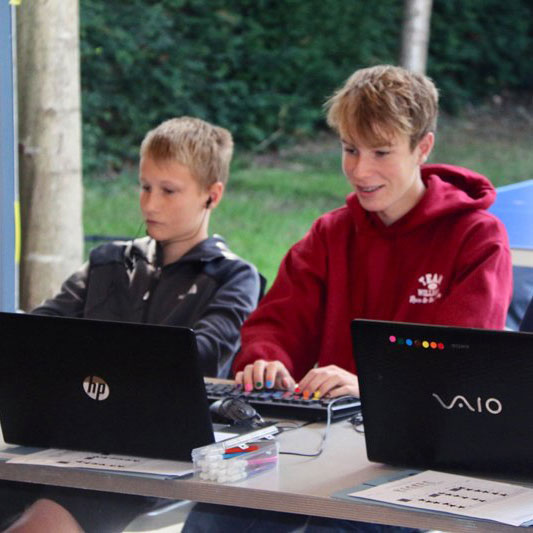
Students with ADHD often experience challenges with focus, working memory and task completion, which can make writing feel slow, frustrating and mentally exhausting. One of the key benefits of touch typing for ADHD is that it helps reduce many of these common barriers, allowing students to focus more on their ideas rather than the mechanics of typing.
First, touch typing helps lower cognitive load. When students are constantly looking down at the keyboard, searching for keys and correcting mistakes, a large amount of mental energy is spent on the physical act of typing. For someone with ADHD—where attention is already a limited resource—this extra demand can interrupt concentration and derail thinking. Touch typing automates the typing process, freeing up more mental energy for comprehension, creativity and written expression.
Another major benefit of touch typing for ADHD is improved support for working memory. If a student pauses frequently to search for keys, they are more likely to lose track of what they were about to write. Touch typing allows thoughts to flow more naturally from mind to screen, reducing interruptions and helping students hold onto ideas more effectively.
Touch typing can also improve focus and flow. Looking back and forth between the keyboard and screen creates constant visual interruptions, which can make it harder for students with ADHD to stay engaged in a task. By learning to type without looking at the keyboard, students can maintain better concentration while writing essays, taking notes or completing homework.
There are also clear benefits for speed and task completion. Many students with ADHD struggle to start or finish written work, particularly when the process feels slow or frustrating. Faster typing helps reduce that barrier. When writing feels smoother and more efficient, there is often less resistance to getting started and more momentum to continue.
Another important advantage is reduced frustration and emotional load. Slow progress, repeated small errors and physical awkwardness can build frustration over time and lead to avoidance. Touch typing makes writing feel more natural and less effortful, helping improve confidence and willingness to engage with written tasks.
Touch typing can also support note-taking and learning in real time. In lessons or lectures, students with ADHD may miss important information if they cannot write quickly enough. Typing more efficiently allows them to capture information more effectively without constantly switching attention between listening and writing.
In short, touch typing transforms typing from a distracting obstacle into an automatic skill. For students with ADHD, that shift can make a significant difference to focus, confidence and overall academic performance.
One of the QWERTY Type founders, Clare, originally set up the business after struggling to find a suitable touch typing course for her son Charlie, who was diagnosed with ADHD. At the time, Charlie was 12 years old and Clare wanted a course that was supportive, engaging and taught by qualified teachers.
Charlie completed the course typing at over 30 WPM and is now 20 years old. Since learning to touch type, he has completed his GCSEs, A-Levels and university work using a laptop for exams and coursework.
Great course for kids! 🙂
This is a great course. My son has ADHD and generally has to be dragged to things kicking and screaming! He went to this course enthusiastically and has already reached nearly 30 wpm. Teachers were great – communicative, helpful and organised. Highly recommend this course.
Anne Kay
Help Your Child Build Confidence with Touch Typing
At QWERTY Type, our touch typing courses are designed to support children and teens with a wide range of learning needs, including ADHD. Lessons are taught by qualified teachers and designed to improve typing speed, confidence and independence in school and beyond.